Spring storms in the Greater Atlanta area don’t announce themselves politely. One week, everything feels calm, and the next you’re dealing with wind-driven rain, clogged drains, or a leak that didn’t exist the day before.
For commercial property owners and facility managers in Marietta, Kennesaw, Acworth, Woodstock, and the surrounding metro areas, planning and preparing for these storms in February can make a huge difference in how your roof holds up. Once spring storms arrive, crews get busy, small issues turn into emergencies, and reaction replaces prevention. You don’t want your property dealing with that chaos.
Understanding the storm patterns that hit Greater Atlanta every year allows you to get ahead of problems instead of responding to them after damage is done.
1. Fast-Moving Thunderstorms With Heavy Rain
One of the most common spring storm patterns in Greater Atlanta is the fast-moving thunderstorm that dumps a large amount of rain in a short time.
These storms are especially hard on:
- Flat and low-slope commercial roofs
- Buildings with aging or undersized drainage systems
- Properties surrounded by trees
In areas like Kennesaw and Acworth, debris buildup combined with sudden rainfall can overwhelm roof drains quickly. When water can’t move off the roof fast enough, ponding occurs, and ponding water always finds weak points.
Before spring storms begin, drains and gutters should be inspected and cleared. This is one of the simplest ways to prevent avoidable leaks.
2. Wind-Driven Rain (Not Just “Rain”)
In Greater Atlanta, rain rarely falls straight down during storms. Strong winds push water sideways, forcing it into places it normally wouldn’t go.
Wind-driven rain commonly causes:
- Leaks at flashing and edges
- Water intrusion around rooftop HVAC units
- Issues at wall-to-roof transitions
This type of damage is common when commercial buildings have multiple penetrations and rooftop equipment. Be sure to conduct pre-storm inspections that focus on seams, flashing, curbs, and transitions—not just the open membrane.
3. Straight-Line Wind Events
Spring storms in the Atlanta area don’t always involve tornadoes, but straight-line winds can be just as damaging to commercial roofs.
These winds can:
- Lift roof edges
- Loosen flashing
- Stress seams and fasteners
- Displace rooftop equipment
Damage from straight-line winds isn’t always obvious from the ground, but it often leads to leaks weeks or months later. Facilities should schedule inspections after major wind events, even if no immediate leaks are visible.
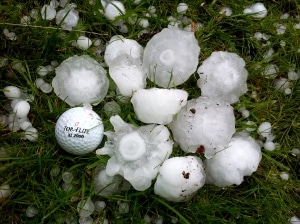
4. Hail That Causes “Invisible” Damage
Hailstorms in Greater Atlanta are unpredictable and often localized. One property may be hit while another, a few miles away, is untouched.
Hail damage doesn’t always create visible holes. Instead, it can:
- Bruise membranes
- Weaken seam welds
- Shorten a roof’s lifespan without immediate signs
We frequently see this type of damage in Cobb and Cherokee County properties that don’t realize anything is wrong until the next storm. If hail passes through your area, a professional inspection should happen immediately, especially for insurance documentation.
5. Repeated Storm Cycles Over Short Periods
Spring storms in Greater Atlanta rarely come as a single event. It’s more common to see multiple storms roll through over several weeks.
This pattern compounds problems:
- Minor damage worsens with each storm
- Saturated insulation doesn’t have time to dry
- Temporary fixes fail quickly
Buildings in older commercial corridors like Marietta and Kennesaw are especially vulnerable if roofs are already near the end of their service life. February is the time to identify small issues and address them before repeated storms turn them into major repairs.
Why February Planning Matters
Once spring storms start, roofing schedules fill up fast. Facility managers who plan ahead benefit from:
- Fewer emergency repairs
- Better control over budgets
- Stronger insurance documentation
- Less disruption to tenants and operations
A proactive inspection in February can prevent costly downtime in March, April, and May.
Taking Care of Your Commercial Roof this Spring
Storm damage in Greater Atlanta isn’t random, and it typically follows predictable patterns. Facility managers who understand those patterns and prepare early put their properties in a far stronger position heading into spring.
Planning now doesn’t just protect your roof, but your budget, your tenants, and your peace of mind.